Torsional Resistance and Micro-Drift
When mounting a 400mm f/2.8 or 600mm f/4 prime lens, gravitational torque creates microscopic creeping around the ball sphere after the primary locking collar has engaged. This displacement, known as micro-drift, ruins precise macro framing and degrades astronomical exposures.
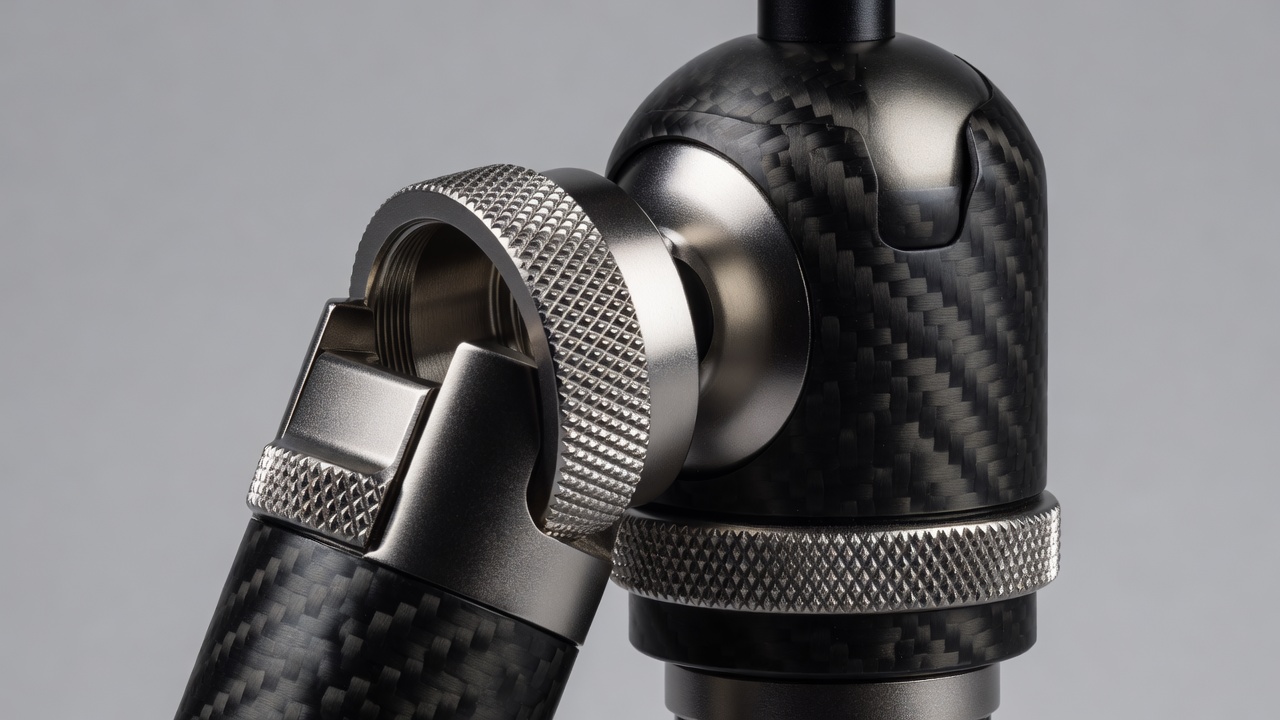
Tripod Vibration Decay Rate Graphs
We apply a calibrated 2.5 Joule mechanical impulse to the camera body plate and measure the oscillation decay time using dual-axis laser vibrometry.
The Geometry of Aspherical Balls
Standard spherical balls increase their friction rate linearly, requiring heavy clamping force that risks overshooting composition. Aspherical ellipsoidal balls progressively increase resistance as the camera tilts away from plumb horizontal, naturally compensating for gravity's increasing lever arm.
Dual-Drop Notch Housings
Machined from aircraft 7075 aluminum to allow rapid transition to vertical portraits without raising the tripod center column.
Arca-Swiss Precision Clamps
CNC milled Dovetail channels equipped with safety stop-pins to prevent inadvertent slide-out under heavy payloads.